Newsfront Online Newsfront Online

Based on media reports, discerning Nigerians are united in their opinion that the country is not just experiencing “security challenges” or facing “isolated incidents.” It is a glaring case of the country hemorrhaging from a thousand cuts while the governing class issue platitudinal statements and postpone trips.
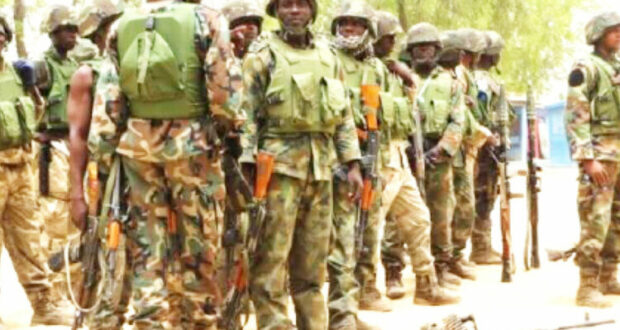
Recently, ISWAP fighters didn’t just ambush soldiers on Damboa Road in Borno. They executed Brigadier General M. Uba after capturing him alive. A two-star general. Think about that for a moment. These aren’t ragtag criminals anymore. They’re organised, emboldened, and operating with disturbing sophistication.
Also, over 30 bandits on motorbikes descended on Fegin Baza village in Zamfara, killing three people including an All Progressive Congress (APC )chieftain, and abducting 64 civilians. Women. Children. Ordinary Nigerians going about their lives. The attackers struck just minutes after the state commissioner of police’s convoy passed through. Either that’s incredibly bad timing, or someone knew exactly when to strike.
Soon, it was the turn of Kebbi as gunmen scaled the fence of Government Girls Comprehensive Secondary School in Maga town before dawn and took as gift items 25 schoolgirls, some barely 13 years old. They shot dead Hassan Makuku, a school official, and left his body as a warning. Twenty-four of those girls are still missing. Their parents are still waiting. The search continues, but so does the familiar, sickening pattern we thought we’d left behind after Chibok and Dapchi.
In North central, bandits were shooting up a church. Christ Apostolic Church in Eruku, Kwara state, to be specific. They stormed a live-streamed prayer service, killed at least three worshippers, and kidnapped the lead pastor along with others. The congregation’s prayers were interrupted by gunfire. In a church. During evening service.
We could go on. In similar fashion the criminals abducted four rice farmers in Edu, Kwara. Just as gunmen killed a traditional leader in Sabon Birni, Sokoto, and abduct 15 people including four nursing mothers with their babies.
In Yobe, ISWAP attacked a police outpost in Geidam, Yobe, killed an officer, burned patrol vehicles. And then came the gut-punch: over 300 pupils and 12 teachers taken from St. Mary’s Catholic Schools in Agwara, Niger state, despite prior security warnings that nobody acted on. This isn’t a security report. It’s a chronicle of state failure playing out in real time across northern Nigeria.
President Bola Tinubu postponed his trip to South Africa and Angola to await security briefings. He ordered more security personnel to Eruku. He directed the police to go after the bandits. He asked the Minister of State for Defence, Bello Matawalle to relocate to Kebbi. These are responses. What we need is a solution.
The president closed 47 Unity Colleges nationwide citing security concerns. That’s an admission that the government cannot protect schoolchildren on federal property. Read that sentence again. The federal government of Nigeria, with all its security apparatus, cannot guarantee the safety of students in its own schools. So the answer is to shut them down and send the children home. To where, exactly? Their communities, where bandits operate with impunity?
Here’s what nobody in government wants to say out loud: Nigeria is at war. Not the kind of war with formal declarations and enemy states, but a war nonetheless. Soldiers are dying in battlefields. School children are being snatched from their classrooms. Worshippers are being gunned down in churches. Farmers can’t go to their fields. The roads are death traps. This is war, and we’re losing.
President Tinubu needs to stop treating this like a management problem that can be solved with better coordination and more briefings. This requires emergency powers. A state of emergency on insecurity isn’t an admission of failure anymore. It’s the only honest response left.
But even emergency declarations won’t work if we keep ignoring the elephant in the room: complicity. The Kebbi governor Nasir Idris revealed that soldiers withdrew 30 minutes after the school kidnapping. Who gave that order? Why were they pulled back when children were being taken? These aren’t rhetorical questions. Somebody made that decision, and somebody needs to answer for it.
And while we’re asking uncomfortable questions, what happened to the list of terrorism sponsors that the United Arab Emirates gave Nigeria? Did it disappear into some filing cabinet? Are those names too powerful to touch? Because it’s becoming painfully obvious that this level of sustained insurgency doesn’t happen without funding, logistics, and intelligence. Somebody is bankrolling these operations. Somebody is providing the weapons. Somebody knows when security convoys will pass through.
The attacks on schools and churches are particularly chilling given recent international attention. The United States just designated Nigeria a country of particular concern on religious freedom. Now churches are being shot up during prayer services. Some will say the timing is coincidental. Others will point to political calculations. We don’t care about the conspiracy theories. We care about the bodies.
There’s talk that the escalating violence is designed to undermine Tinubu’s potential second-term bid. Maybe. But the president needs to understand something fundamental: all his economic reforms, all his policy initiatives, all his international diplomacy will count for exactly nothing if Nigeria descends further into chaos. You can’t run a functional economy when bandits control territory. You can’t attract investment when schoolgirls are being kidnapped. You can’t talk about growth when farmers are too terrified to plant crops.
Tinubu faces a choice that will define his legacy. He can treat this as a political problem to be managed with careful statements and symbolic gestures. Or he can recognise it for what it is: an existential threat to the Nigerian state that requires every ounce of presidential authority and political capital he possesses.
That means declaring an emergency on insecurity and meaning it. It means purging the security agencies of compromised elements. It means going after terrorism sponsors regardless of their political connections. It means putting generals in the field,It means accepting that some sacred cows will have to be slaughtered if Nigeria is going to survive.
The president suspended his international trips to deal with this crisis. Good. Now suspend everything else until it’s fixed. No political rallies. No party conventions. No calculations about 2027. Just the singular focus of a commander-in-chief at war. Because make no mistake about it, we are at war. The question is whether our president is ready to fight it.
(LEADERSHIP)